The 3-Carat+ Standard: A Guide to Investment-Grade Natural Diamonds
Understanding the threshold where exceptional jewelry becomes a portfolio-grade asset
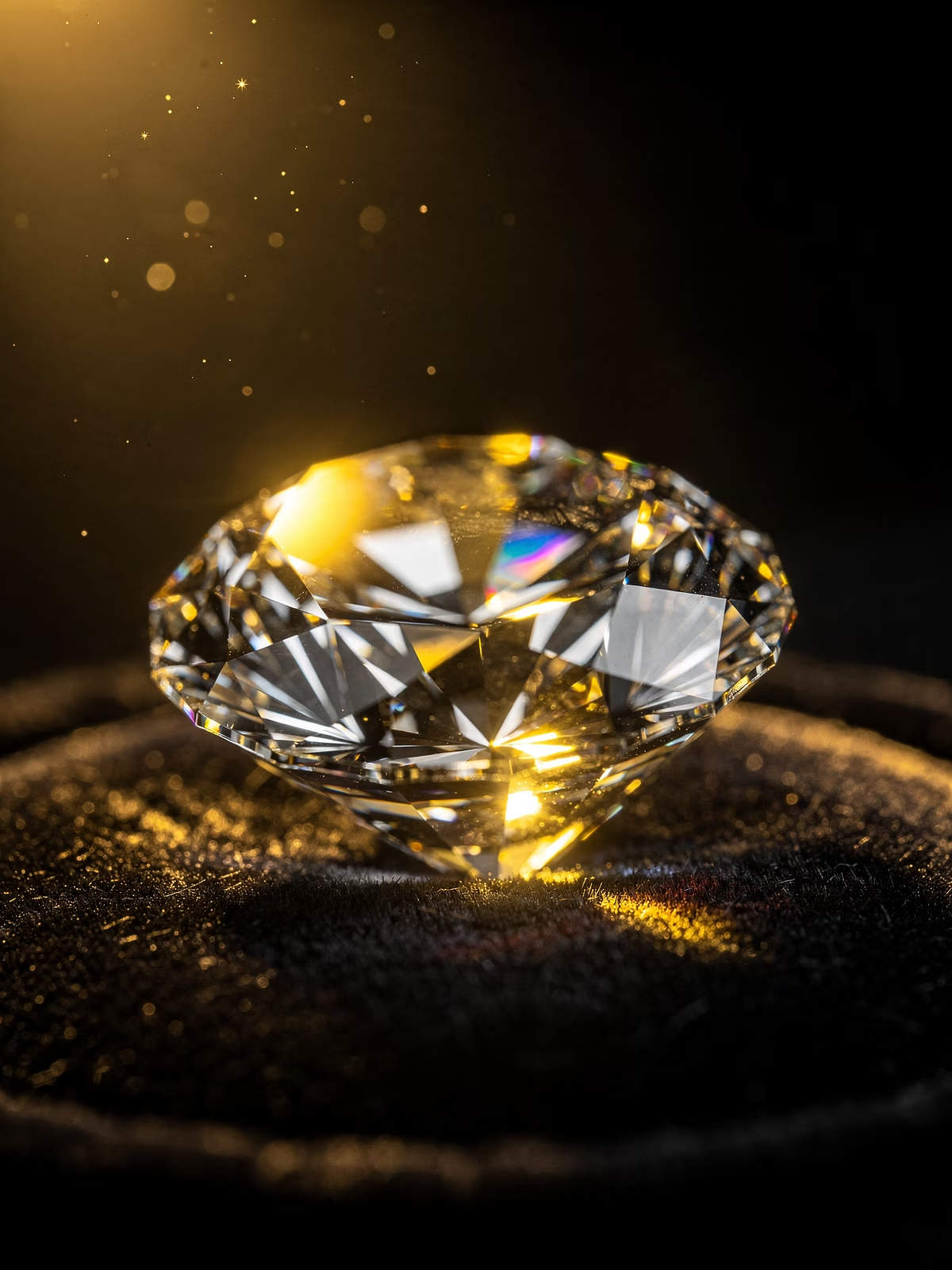
The Significance of 3 Carats
Where Jewelry Becomes Asset
The 3-carat threshold represents a fundamental shift in how the market perceives natural diamonds. Below this weight, stones are primarily valued for their aesthetic and emotional significance. Above it, diamonds enter the realm of tangible assets—finite resources with documented scarcity and measurable investment characteristics.
This distinction is rooted in supply dynamics. Stones exceeding 3 carats constitute less than 1% of global diamond production, yet command a disproportionate share of total market value. Their relative scarcity creates pricing power that smaller stones simply cannot achieve, making them increasingly attractive to wealth managers and private collectors seeking alternative asset diversification.
For high-net-worth individuals, 3-carat+ natural diamonds offer a unique combination of portability, privacy, and permanence. Unlike traditional securities, they require no custodian. Unlike real estate, they occupy no physical footprint. Their value is intrinsic, globally recognized, and historically resilient across economic cycles.
<1%
Global Production
Diamonds exceeding 3 carats represent less than 1% of total output
15-20%
Annual Appreciation
Historical price growth for top-quality large stones
100%
Portable Wealth
Fully liquid, jurisdiction-independent asset class
The 10-Carat Pinnacle
Extreme Rarity
Diamonds exceeding 10 carats represent the top 0.1% of global production—a level of scarcity comparable to masterwork paintings or rare collectible automobiles. At this scale, each stone is effectively unique, with no two sharing identical characteristics.
Provenance Premium
Stones of this magnitude often carry documented histories, auction records, and gemological pedigrees that further enhance their investment profile. They are assets that appreciate not only with market dynamics but with the narrative of ownership itself.
Market Dynamics
Supply constraints at the 10-carat+ level are structural, not cyclical. Major mining operations report decreasing yields of large rough, while demand from sovereign wealth funds, private collectors, and family offices continues to intensify.
Understanding Scale and Scarcity
To produce a single 10-carat polished diamond requires the extraction and processing of approximately 250 million tons of ore. This ratio—250 million to one—underscores why stones of this caliber command exponential premiums over smaller counterparts. The economics are simple: as carat weight increases arithmetically, value appreciation follows a geometric curve.
Historical auction data confirms this pattern. Over the past two decades, 10-carat+ diamonds have consistently outperformed equity indices, gold, and smaller diamonds across comparable quality grades. Their performance is particularly pronounced during periods of monetary uncertainty, when tangible, portable assets gain favor among sophisticated investors.
Your Complete Diamond Protection Checklist
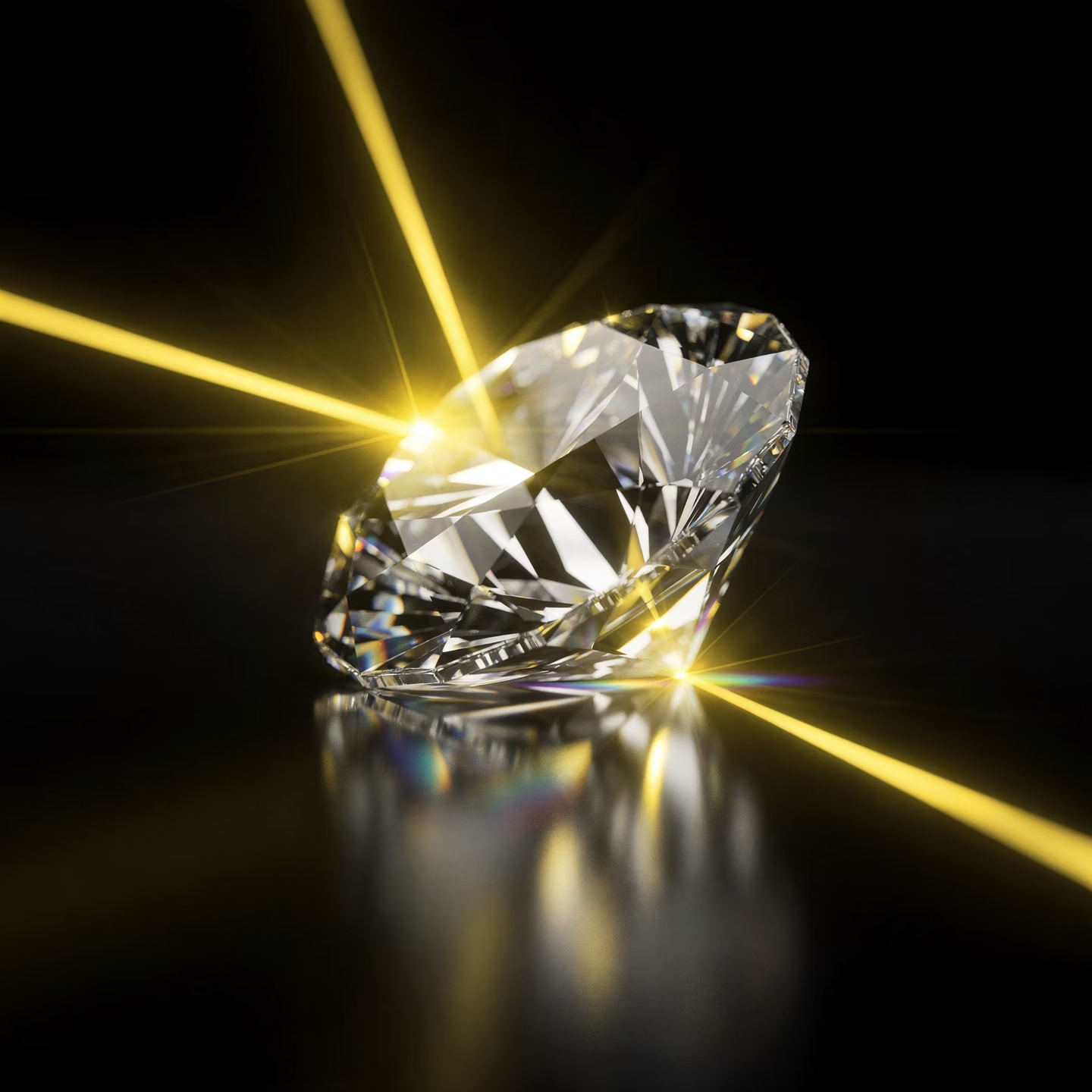
Light Performance: The Cut Precision Standard
In investment-grade diamonds, cut quality is paramount. Light performance—measured through brilliance, fire, and scintillation—determines not only aesthetic appeal but long-term value retention. Stones with superior cut grades return light with maximum efficiency, creating the visual signature that defines exceptional quality.
Gemological laboratories employ advanced photometric analysis to quantify light performance. Only diamonds achieving “Excellent” or “Ideal” cut grades meet institutional standards for portfolio inclusion. This precision ensures that the stone’s optical properties remain stable and verifiable across future appraisals.
Value Retention: Scarcity Versus Demand
Large natural diamonds exhibit value retention characteristics distinct from smaller stones. Their pricing follows a power-law distribution: as carat weight doubles, per-carat value can triple or quadruple, depending on quality parameters. This non-linear relationship reflects fundamental scarcity.
2000-2010
Steady appreciation as Asian wealth creation drives demand for large stones. Average annual returns: 8-12% for 5-carat+ D-F, IF-VVS1 stones.
2010-2020
Acceleration phase. Major mine closures reduce supply. Investment-grade stones appreciate 15-20% annually, outperforming most alternative assets.
2020-Present
Post-pandemic wealth migration into tangible assets. Record auction prices for 10-carat+ stones. Institutional interest intensifies supply-demand imbalance.
Buying for the Portfolio
Diamonds as Wealth Preservation
For high-net-worth individuals, natural diamonds exceeding 3 carats represent a strategic allocation within alternative asset portfolios. Their value proposition rests on three pillars: intrinsic scarcity, historical price resilience, and operational flexibility. Unlike traditional securities, diamonds carry no counterparty risk. Unlike real estate, they require no management overhead. Their worth is self-contained, globally fungible, and immune to jurisdictional constraints.
Institutional investors and family offices increasingly view large natural diamonds as a hedge against monetary debasement and geopolitical uncertainty. The asset class offers non-correlation with equity markets, zero carrying costs, and complete discretion. In an era of capital controls and digital surveillance, diamonds provide a level of privacy and portability unmatched by conventional stores of value.
Portfolio Diversification
Investment-grade diamonds exhibit low correlation with equities, bonds, and real estate. Their inclusion reduces overall portfolio volatility while maintaining growth potential. Recommended allocation: 5-10% for ultra-high-net-worth portfolios.
Generational Transfer
Diamonds are among the most efficient vehicles for intergenerational wealth transfer. Compact, durable, and exempt from many reporting requirements, they facilitate discreet estate planning with minimal tax friction across jurisdictions.
Liquidity Considerations
Contrary to common perception, investment-grade diamonds maintain robust liquidity through specialist dealers, auction houses, and private networks. Stones with full gemological documentation and established provenance typically transact within 30-90 days.
Due Diligence and Acquisition
Acquiring portfolio-grade diamonds requires specialized expertise. Each stone must carry certification from a recognized gemological laboratory—GIA, AGS, or equivalent. Documentation should include detailed photometry, fluorescence analysis, and inscription verification. Provenance research, while not mandatory, adds material value for stones with notable histories or previous auction records.
Pricing transparency has improved significantly with the digitization of trade data. However, the market for large stones remains relationship-driven. Access to premium inventory often requires established dealer networks, private viewings, and confidential negotiations. Working with a trusted specialist ensures competitive pricing and authentication integrity.
Ready to explore investment-grade diamonds? Our private client advisors provide confidential consultations, portfolio analysis, and access to curated inventories of 3-carat+ natural stones. Contact us to schedule a discreet, no-obligation review.